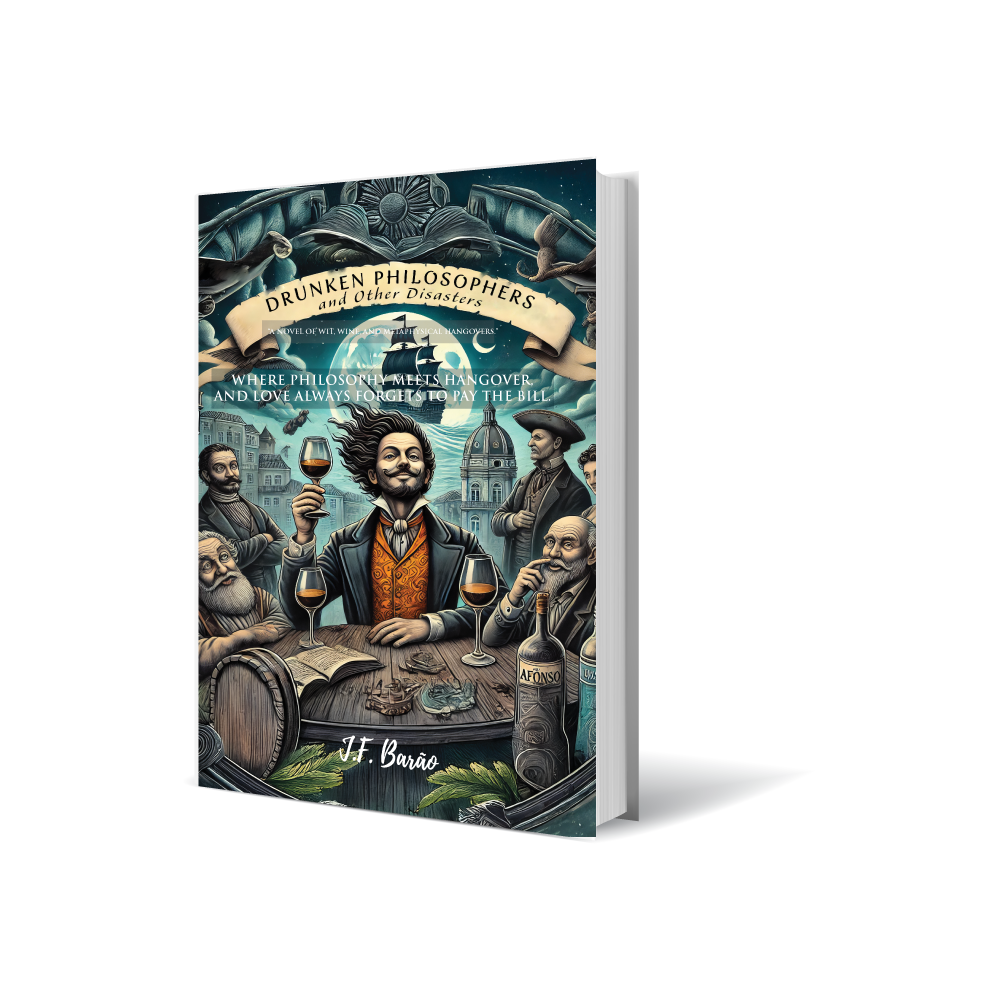
What happens when philosophers stop thinking and start drinking?
In Drunken Philosophers and Other Disasters, a motley crew of poets, kings, and existential troublemakers gather in a Lisbon bar to debate love, history, and the unbearable weight of being human—usually after one drink too many. As conversations spiral into chaos, friendships are forged, illusions collapse, and wisdom arrives late, slurring its words.
Equal parts satire and soul-searching, this novel is a love letter to lost causes, broken hearts, and the glorious mess of trying to make sense of life before last call.
Because in the end, everything does.
An audio overview of the book.Deep Dive Podcast
Drunken Philosophers and Other Disasters
Prologue
The tavern smelled of old wood, spilled wine, and the faintest trace of regret—probably from the man in the corner who’d just realized he’d spent his last coins buying drinks for strangers who’d already left.
A low fire crackled in the hearth, throwing shadows across faces long since etched into history.
Had anyone bothered to check the date, they might’ve noticed something was off—because, by all reasonable accounts, the men gathered around that oak table didn’t belong in the same century, let alone the same room.
Afonso Henriques, Portugal’s first king, took a deep swig of beer, slammed the mug down, and sighed contentedly.
“You lot are all poets and philosophers,” he said, ”but when it comes to living, you don’t know your ass from a hole in the ground.”
“I’d rather have my head in the clouds than stuck in a battlefield covered in blood and shit,” Camões retorted, swirling his wine as though it contained the universe’s final draft.
Zarathustra adjusted the snake around his neck and raised an eyebrow.
“Ah, but isn’t life itself a battlefield? One must conquer the self before conquering the world.”
Bocage snorted, already halfway to oblivion.
“You know, I always say—philosophy is just poetry with a stick up its ass.”
Socrates, ever patient, watched the bickering with a thoughtful calm.
“Perhaps,” he said, “but poetry is simply philosophy wearing a prettier dress.”
The argument might’ve gone on forever—a drunken waltz between truth and nonsense, so intertwined it was impossible to tell which was leading—until, inevitably, someone ruined the mood.
“Enough about philosophy and poetry,” said Zézito, wiping his mouth with the back of his hand. “What happened to Juca?”
Silence.
A weight settled over the table, thick as the smoke curling from the lanterns above.
Juca.
The one who’’d poured his heart out and ended up with nothing but a bruised ego and an empty glass.
The one who’d loved too much—or maybe just wrong.
The one who, despite all his attempts to run, to drink, to forget, always found himself back at the same table, staring into the same abyss, hoping—just once—that the abyss would look away.
The night stretched on, and the stories flowed like the wine.
Truths, half-truths, and outright lies tangled together in a web of memory and myth.
Somewhere between laughter and lament, between wisdom and foolishness, the answer to Juca’s fate lay waiting—buried in the bottom of a glass, or perhaps in the silence that followed the last toast.
Outside, the city slept—unaware that the men at this table would soon outlive even its walls.
Their laughter would sail across oceans, outlast empires, and return—as all things do—to the same barstool, unchanged.
And Zézito, faithful chronicler of disasters, poured another round—because some truths only surface after the third drink.
Excerpt From
Drunken Philosophers and Other Disasters
J.F. Barão
This material is protected by copyright.
Coming Soon